
The Struggle of the Believer After Accepting Christ
THE TRUTH ABOUT MODERN RELATIONSHIPS
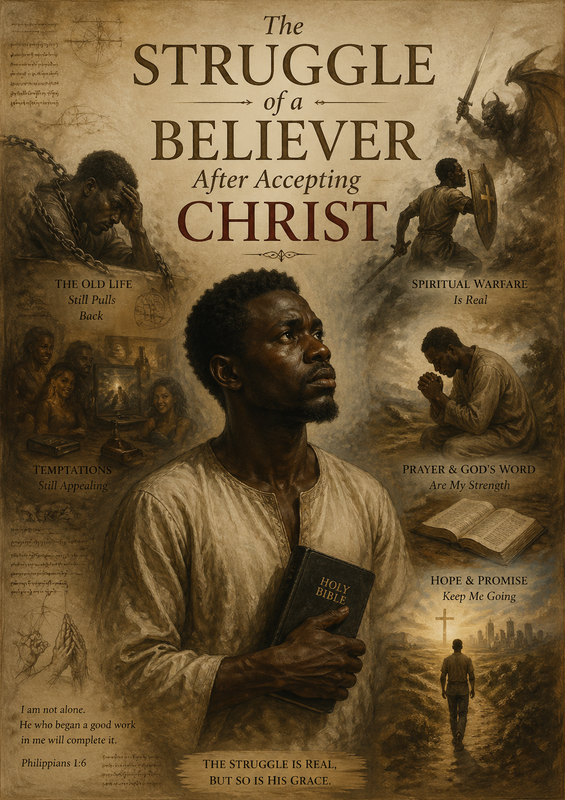
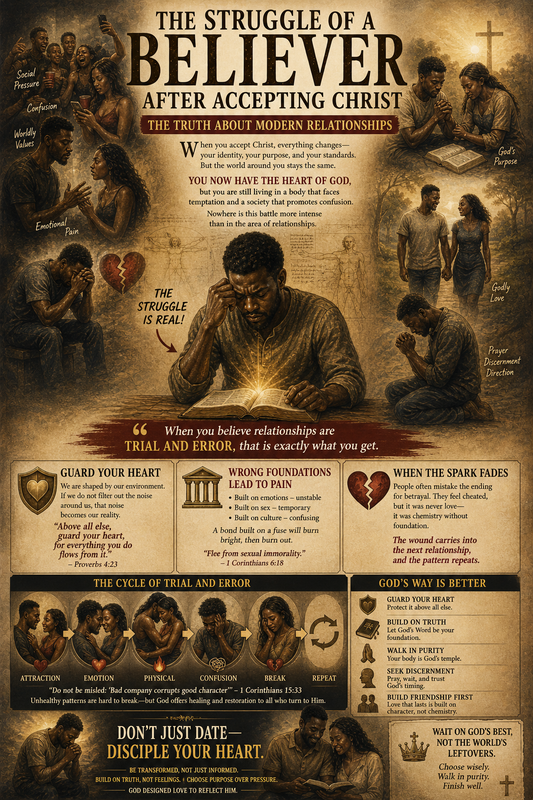

"When you accept Christ, everything changes your identity, your purpose, and your standards. But the world around you stays the same. This creates a struggle: You now have the heart of God, but you are still living in a body that faces temptation and a society that promotes confusion. Nowhere is this battle more intense than in the area of relationships.
Many believers know the Bible but don't know how to date or how to choose a spouse. This article bridges that gap.
When you believe relationships are trial and error, that is exactly what you get.
We are shaped by our environment, and if we do not filter out the noise around us, that noise becomes our reality. The Bible teaches that our hearts are easily influenced.
"Above all else, guard your heart, for everything you do flows from it" (Proverbs 4:23).
When we adopt the world’s view that love is merely a series of experiments, we set ourselves up for disappointment.
While physical intimacy is a natural part of healthy relationships, many people use this as justification to rush into it when entering a new connection. The result is a bond built on a fuse rather than a foundation—burning bright, then burning out. Scripture reminds us that our bodies are temples of the Holy Spirit, created for holiness, not for casual or premature union.
"Do you not know that your bodies are members of Christ himself? Shall I then take the members of Christ and unite them with a prostitute? Never! ... Flee from sexual immorality. All other sins a person commits are outside the body, but whoever sins sexually, sins against their own body" (1 Corinthians 6:15, 18).
When that spark fades, people often mistake the ending for betrayal. They feel cheated, not necessarily because their partner wronged them, but because the chemistry they mistook for love has disappeared. They carry that wound into the next relationship, and the pattern repeats. This is how trial and error becomes a lifestyle rather than a lesson. The apostle Paul warns.
"Do not be misled: 'Bad company corrupts good character'" (1 Corinthians 15:33).
Unhealthy patterns, once formed, are hard to break — but God offers healing and restoration to all who turn to Him.
HOW RELATIONSHIPS SHOULD ACTUALLY WORK
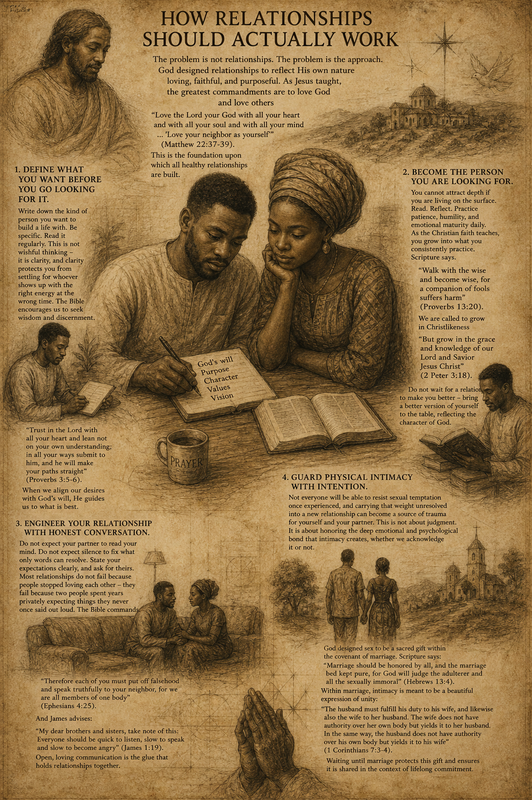
The problem is not relationships. The problem is the approach.
God designed relationships to reflect His own nature loving, faithful, and purposeful. As Jesus taught, the greatest commandments are to love God and love others
"Love the Lord your God with all your heart and with all your soul and with all your mind' ... 'Love your neighbor as yourself'" (Matthew 22:37-39).
This is the foundation upon which all healthy relationships are built.
1. Define what you want before you go looking for it.
Write down the kind of person you want to build a life with. Be specific. Read it regularly. This is not wishful thinking it is clarity, and clarity protects you from settling for whoever shows up with the right energy at the wrong time. The Bible encourages us to seek wisdom and discernment.
"Trust in the Lord with all your heart and lean not on your own understanding; in all your ways submit to him, and he will make your paths straight" (Proverbs 3:5-6).
When we align our desires with God’s will, He guides us to what is best.
2. Become the person you are looking for.
You cannot attract depth if you are living on the surface. Read. Reflect. Practice patience, humility, and emotional maturity daily. As the Christian faith teaches, you grow into what you consistently practice. Scripture says.
"Walk with the wise and become wise, for a companion of fools suffers harm" (Proverbs 13:20).
We are called to grow in Christlikeness
"But grow in the grace and knowledge of our Lord and Savior Jesus Christ" (2 Peter 3:18).
Do not wait for a relationship to make you better — bring a better version of yourself to the table, reflecting the character of God.
3. Engineer your relationship with honest conversation.
Do not expect your partner to read your mind. Do not expect silence to fix what only words can resolve. State your expectations clearly, and ask for theirs. Most relationships do not fail because people stopped loving each other they fail because two people spent years privately expecting things they never once said out loud. The Bible commands.
"Therefore each of you must put off falsehood and speak truthfully to your neighbor, for we are all members of one body" (Ephesians 4:25).
And James advises:
"My dear brothers and sisters, take note of this: Everyone should be quick to listen, slow to speak and slow to become angry" (James 1:19).
Open, loving communication is the glue that holds relationships together.
4. Guard physical intimacy with intention.
Not everyone will be able to resist sexual temptation once experienced, and carrying that weight unresolved into a new relationship can become a source of trauma for yourself and your partner. This is not about judgment. It is about honoring the deep emotional and psychological bond that intimacy creates, whether we acknowledge it or not.
God designed sex to be a sacred gift within the covenant of marriage. Scripture says:
"Marriage should be honored by all, and the marriage bed kept pure, for God will judge the adulterer and all the sexually immoral" (Hebrews 13:4).
Within marriage, intimacy is meant to be a beautiful expression of unity:
"The husband must fulfill his duty to his wife, and likewise also the wife to her husband. The wife does not have authority over her own body but yields it to her husband. In the same way, the husband does not have authority over his own body but yields it to his wife" (1 Corinthians 7:3-4).
Waiting until marriage protects this gift and ensures it is shared in the context of lifelong commitment.
WHY YOU SHOULD NOT MARRY SOMEONE WHO DOES NOT SHARE YOUR BELIEFS
This may be one of the most important decisions you will ever make, yet it is often overlooked.
A person can be loving, kind, and genuinely amazing and still be the wrong partner for you. Faith is not a small detail. It is one of the most powerful forces that shapes how a person thinks, decides, parents, grieves, forgives, and finds meaning. When two people marry with fundamentally different worldviews, it is not a matter of if that difference will surface it is a matter of when.
It becomes a red line after marriage.
Before marriage, differences are easy to romanticize. After marriage, those same differences become daily friction. One person may suppress their convictions to keep the peace, smiling through disagreements they never voice. But silence is not resolution. That pressure builds over years and eventually surfaces as resentment, distance, or an ultimatum neither of you saw coming.
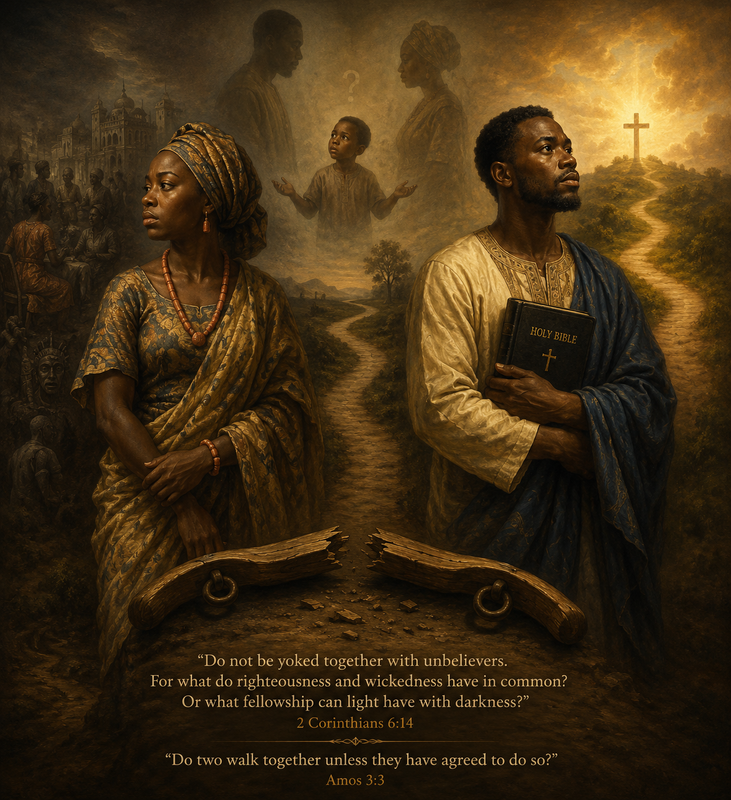
The Bible clearly warns against being unequally yoked:
"Do not be yoked together with unbelievers. For what do righteousness and wickedness have in common? Or what fellowship can light have with darkness?" (2 Corinthians 6:14).
This principle is rooted in God’s desire for unity and harmony. As Amos asks:
"Do two walk together unless they have agreed to do so?" (Amos 3:3).
When our core beliefs differ, walking together becomes difficult.
It creates a confused generation.
Your children will inherit the tension you normalize. When a home carries two competing belief systems without clear direction, children do not get the best of both worlds; they get uncertainty. This leads to a blending of beliefs that dilutes truth rather than enriches it. Children raised without a clear foundation are not freer—they are left to navigate life's hardest questions without a map.
God calls parents to raise their children in His truth:
"These commandments that I give you today are to be on your hearts. Impress them on your children. Talk about them when you sit at home and when you walk along the road, when you lie down and when you get up" (Deuteronomy 6:6-7).
A home united in faith provides the stability and guidance children need to grow spiritually. Joshua declared.
"But as for me and my household, we will serve the Lord" (Joshua 24:15) — a model for all families to follow.
A few people make it work, but it requires exceptional commitment.
Some couples successfully navigate interfaith marriages, but it does not happen by accident. It requires deliberate, ongoing conversation and a clear decision about what will anchor the home. Even then, family pressures and social expectations remain. The decisions you make in private ripple outward to everyone around you.
It is important to note that the Bible also offers grace for those already in mixed-faith marriages. Paul writes:
"If any brother has a wife who is not a believer and she is willing to live with him, he must not divorce her. And if a woman has a husband who is not a believer and he is willing to live with her, she must not divorce him. For the unbelieving husband has been sanctified through his wife, and the unbelieving wife has been sanctified through her believing husband" (1 Corinthians 7:12-14).
In such cases, the believing partner can be a powerful witness, and God can work even in difficult circumstances.
Be wise in your choosing. Consequences do not announce themselves — they simply arrive.
THE BIGGER PICTURE
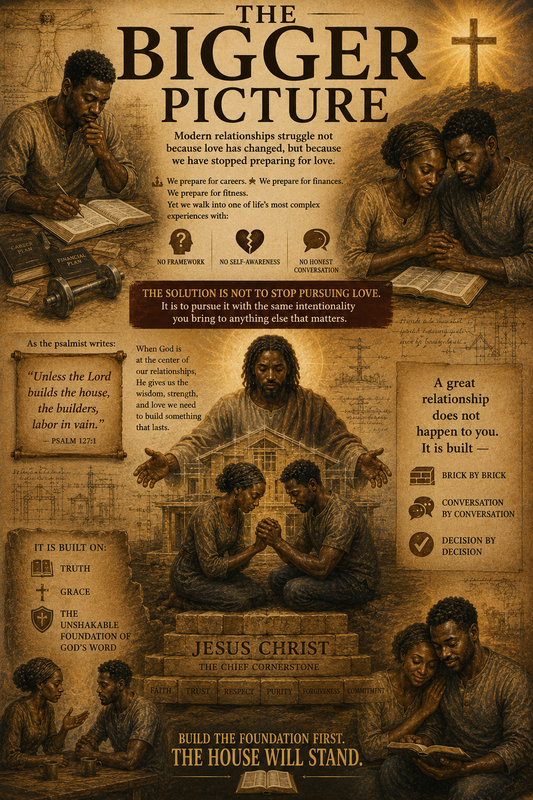
Modern relationships struggle not because love has changed, but because we have stopped preparing for love. We prepare for careers, for finances, for fitness yet we walk into one of life's most complex experiences with no framework, no self-awareness, and no honest conversation.
The solution is not to stop pursuing love. It is to pursue it with the same intentionality you bring to anything else that matters. As the psalmist writes:
"Unless the Lord builds the house, the builders labor in vain" (Psalm 127:1).
When God is at the center of our relationships, He gives us the wisdom, strength, and love we need to build something that lasts.
A great relationship does not happen to you. It is built — brick by brick, conversation by conversation, decision by decision. It is built on truth, on grace, and on the unshakable foundation of God’s Word.
Build the foundation first. The house will stand.
📚 Recommended Resources

These books can help you grow further:
- Not Yet Married by Marshall Segal
- Healthy Relationship 101 by Michael Jascz
- The Seven Principles for Making Marriage Work by John M. Gottman
___-___-___-___-___-___-___-___
📢 INTERACT WITH THIS ARTICLE 📢
Please copy, edit, and drop your comment below:
✅ Name:
[Your Name]
✅ What I learned from this article:
[Write your answer here]
✅ How I will implement this knowledge:
[Write your answer here]
✅ Subscribed: ✅ Done
✅ Suggestions for improvement:
[Write your answer here]
✅ Shared: ✅ Shared with groups, friends, and family
Help us grow this page! 🙏
Let us all grow together in grace and
knowledge. 🕊️

Comments
No comments yet. Be the first to comment!