THE HOLY LAND
THE WRONG STATE OF MIND TOWARD WORSHIP: LESSONS FROM 2 KINGS 17:24-41

ABSTRACT
This article examines the theological significance of the Promised Land, the fall of the northern kingdom of Israel, and the emergence of syncretic worship among the Samaritan people as recorded in 2 Kings 17:24-41 (ESV). God established the land as an everlasting possession for Abraham, Isaac, and Jacob—a tangible sign of His covenant faithfulness, provision, and sovereignty, intended to be a place where His people would worship Him in truth. However, Israel’s persistent idolatry, disregard for prophetic warnings, and violation of the covenant led to their exile by Assyria. When new inhabitants settled in Samaria, they initially failed to worship the Lord, prompting divine judgment through lions. Though they sought answers about the God of the land, their guidance came from compromised sources, leading to a blended religion that honored God with lips while hearts remained far from Him. This pattern mirrors challenges faced by believers today: the temptation to serve both God and earthly masters, rationalize compromise, prioritize religious form over heart transformation, and approach faith from fear rather than love. Drawing on Jesus’ teachings in Matthew 6:24 and 11:28, as well as Paul’s exhortation in Romans 12 and John’s words in 1 John 4, this article calls for wholehearted devotion to God alone, rooted in Scripture and received by faith.
THE HOLY LAND: GOD’S COVENANT GIFT
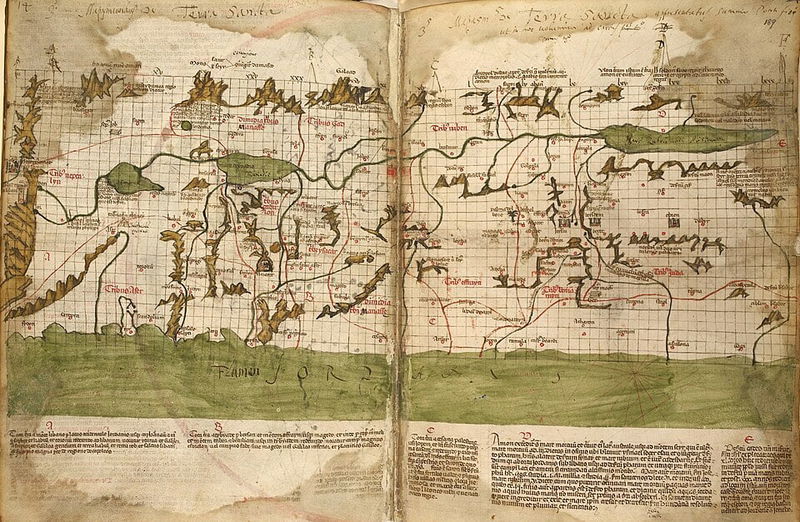
God promised the land to Abraham, saying, “To your offspring I will give this land” (Genesis 12:7 ESV). This promise was reaffirmed to Isaac: “Sojourn in this land, and I will be with you and will bless you, for to you and to your offspring I will give all these lands, and I will establish the oath that I swore to Abraham your father” (Genesis 26:3 ESV). Jacob also received this assurance in a dream at Bethel: “The land on which you lie I will give to you and to your offspring” (Genesis 28:13 ESV). It was designated an everlasting possession, weighted with spiritual meaning beyond its physical boundaries.
The land holds sacred geography, with sites like Jerusalem—the “holy hill” (Psalm 2:6 ESV), Hebron where Abraham, Isaac, and Jacob were buried, and the Jordan Valley where Israel crossed into their inheritance. Deuteronomy 11:12 describes it as “a land that the Lord your God cares for; the eyes of the Lord your God are always on it, from the beginning of the year to the end of the year.”
Theologically, the land represents God’s faithfulness, the fulfillment of His promises, and the covenant relationship between Him and His people. Joshua 22:19 states, “For the Lord has made the Jordan a border between us and you, you Reubenites and Gadites and Manassehites. You have no portion in the Lord. So why do you build for yourselves a house as a rival to the Lord’s sanctuary?”
It was intended to be a place where God’s people would worship Him in truth.
THE FALL OF ISRAEL AND EXILE (2 KINGS 17:1-6 ESV)
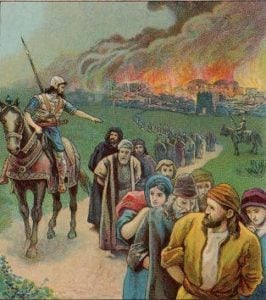
Hoshea son of Elah became the last king of Israel in Samaria, reigning nine years. Scripture notes he “did what was evil in the sight of the Lord, yet not like the kings of Israel who were before him” (2 Kings 17:2 ESV). As a vassal of Assyrian King Shalmaneser V, Hoshea paid tribute until he plotted rebellion by sending envoys to So, king of Egypt, and withholding payment. In response, Shalmaneser besieged Samaria for three years, capturing it in Hoshea’s ninth year of reign.
The Israelites were exiled to Assyria, settled in “Halah, and in Habor, on the river of Gozan, and in the cities of the Medes” (2 Kings 17:6 ESV). The land lay desolate for three years, emptied of the people who had failed to fulfill their covenant purpose.
REASONS FOR THE EXILE (2 KINGS 17:7-23 ESV)
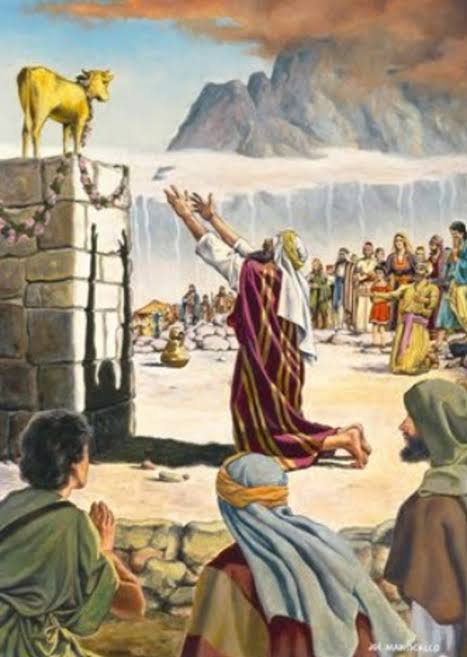
Israel's downfall is attributed in the biblical narrative to covenant infidelity.
- Idolatry: “The people of Israel did what was evil in the sight of the Lord and served the Baals. They abandoned the Lord, the God of their fathers, who had brought them out of the land of Egypt. They went after other gods, from among the gods of the peoples who were around them, and bowed down to them. They provoked the Lord to anger” (2 Kings 17:7-8 ESV).
- Ignoring Prophetic Warnings: “The Lord sent prophets to them, again and again, warning them, because he had compassion on his people and on his dwelling place. But they kept mocking the messengers of God, despising his words and scoffing at his prophets, until the wrath of the Lord rose against his people, until there was no remedy” (2 Kings 17:13-14 ESV).
- Specific Sins: They built high places, set up sacred pillars and Asherah poles, burned incense to false gods, and practiced child sacrifice: “They even burned their sons and their daughters in the fire, which I did not command, nor did it come into my mind” (2 Kings 17:17 ESV).
Final Result: “Therefore the Lord was very angry with Israel and removed them from his sight. None was left but the tribe of Judah only” (2 Kings 17:23 ESV).
THE NEW INHABITANTS AND THE RISE OF THE SAMARITANS (2 KINGS 17:24-41 ESV)
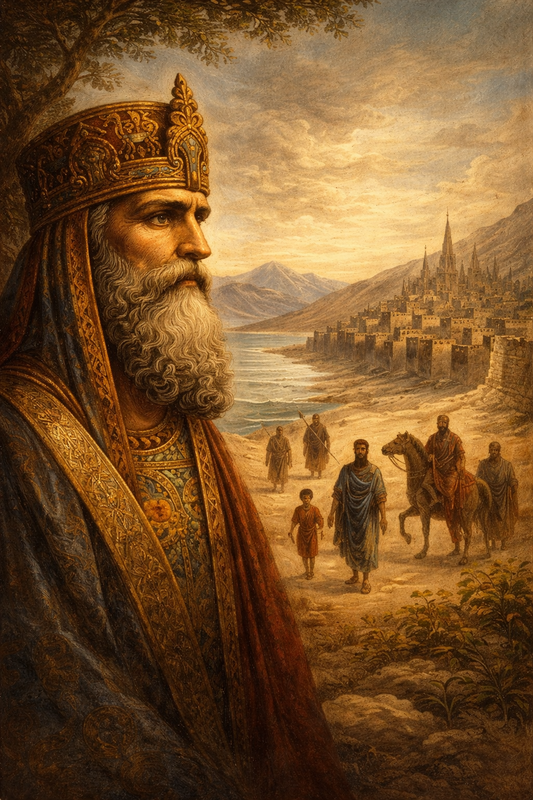
To maintain control of the land and prevent rebellion, the king of Assyria settled people from Babylon, Cuthah, Avva, Hamath, and Sepharvaim in Samaria’s cities.
The Lions: A Sign of God’s Presence
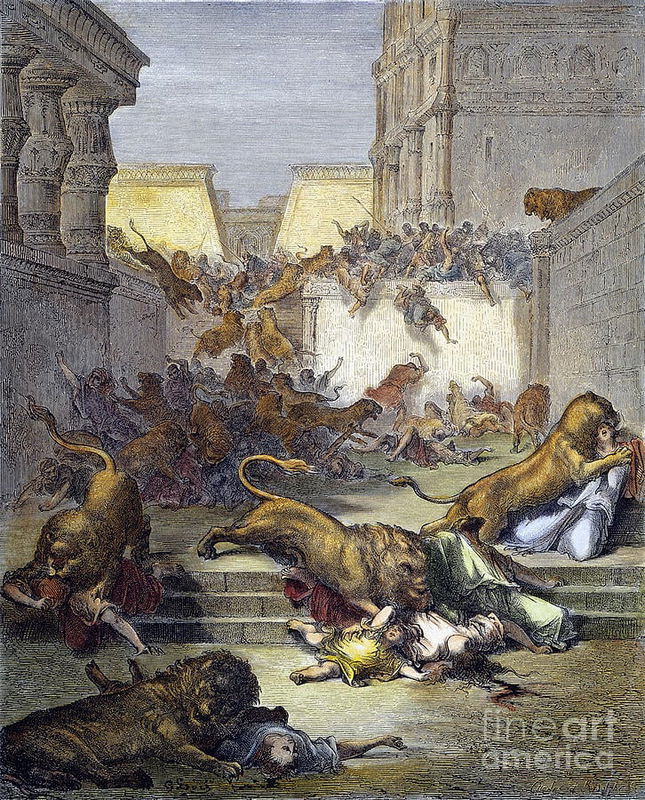
Scripture records: “The king of Assyria brought people from Babylon, Cuthah, Avva, Hamath, and Sepharvaim, and placed them in the cities of Samaria instead of the people of Israel. They took possession of Samaria and lived in its cities. At the beginning of their dwelling there, they did not fear the Lord. Therefore the Lord sent lions among them, which killed some of them” (2 Kings 17:24-25 ESV).
While some might attribute this to natural causes following three years of desolation, the text makes clear it was divine judgment. God sought to reveal his power and presence to these new inhabitants.
As Matthew Henry noted, “The Lord of hosts can serve his purposeby whomever he pleases—small or great, lice or lions.”
He holds all accountable to respond appropriately to the one true God, using various means to awaken sinners to their need for Him (1 Corinthians 15:34 ESV: “Wake up from your drunken stupor, as is right, and do not go on sinning. For some have no knowledge of God. I saythis to your shame.e”).
Seeking Answers: A Mixed Response

When the Assyrian king was told, “The nations that you have carried away and placed in the cities of Samaria do not know the law of the God of the land. Therefore he has sent lions among them, and behold, they are killing them, because they do not know the law of the God of the land” (2 Kings 17:26 ESV), he acted to address the issue.
This response has positive and negative aspects:
- Positive: Unlike Israel, the foreigners did not dismiss their suffering as coincidence or try to manage it on their own. They recognized a connection between their circumstances and their failure to understand the God of the land and sought answers.
- Negative: The guidance they received came from compromised sources. The king sent back a priest from the exiled Israelites, who settled in Bethel—a site tainted by idolatry since Jeroboam’s reign, when golden calves were set up there for worship (1 Kings 12:28-33 ESV). Jeroboam appointed non-Levitical priests, creating a counterfeit system of worship. Thus, the priest sent to teach them likely held a flawed understanding of true worship.
This underscores a critical truth: when believers fail to fulfill their calling to be light to the nations (Colossians 4:5 ESV: “Walk in wisdom toward outsiders, making the best use of the time”), they leave room for false teaching to fill the vacuum. As Scripture warns, we must be careful where we seek spiritual guidance, grounding ourselves in “Scripture alone,” for we will be judged by this book's standards (Revelation 20:12-15 ESV: “And I saw the dead, great and small, standing before the throne, and books were opened. Then another book was opened, which is the book of life. And the dead were judged by what was written in the books, according to what they had done”).
The Result: Syncretic Worship
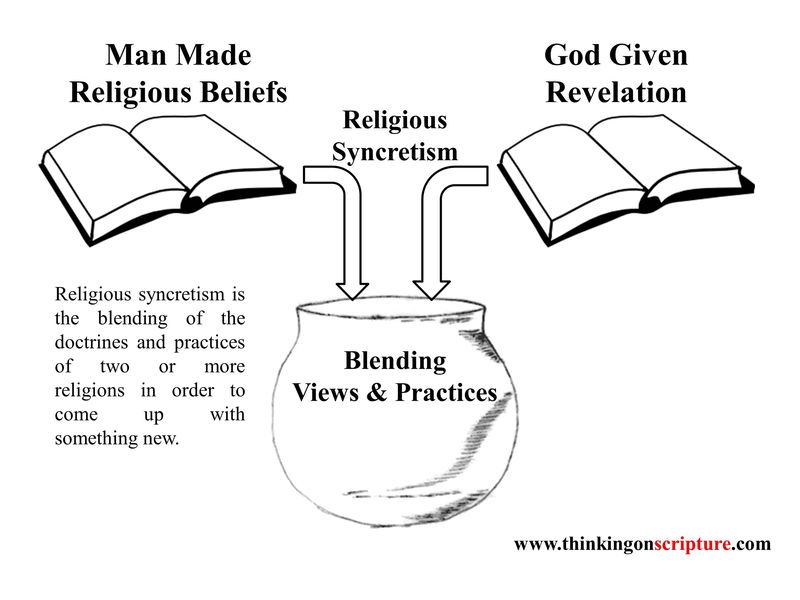
The outcome was predictable: “Every nation made gods of its own and put them in the shrines of the high places that the Samaritans had made. The men of Babylon made Succoth-benoth, the men of Cuth made Nergal, the men of Hamath made Ashima, the Avvites made Nibhaz and Tartak, and the Sepharvites burned their children in the fire to Adrammelech and Anammelech, the gods of Sepharvaim. So they feared the Lord but also served their own gods, after the manner of the nations from among whom they had been carried away” (2 Kings 17:32-34 ESV).
They “feared the Lord” outwardly but continued to worship pagan gods, creating a blended religion. This religious syncretism—viewing idols as intermediaries or additional sources of blessing rather than replacements for God—allowed them to add Yahweh to their pantheon instead of submitting to Him as Lord.
This mirrors Jesus’ rebuke in Matthew 15:8 ESV: “This people honors me with their lips, but their hearts are far from me.”
PARALLELS FOR TODAY: SERVING TWO MASTERS
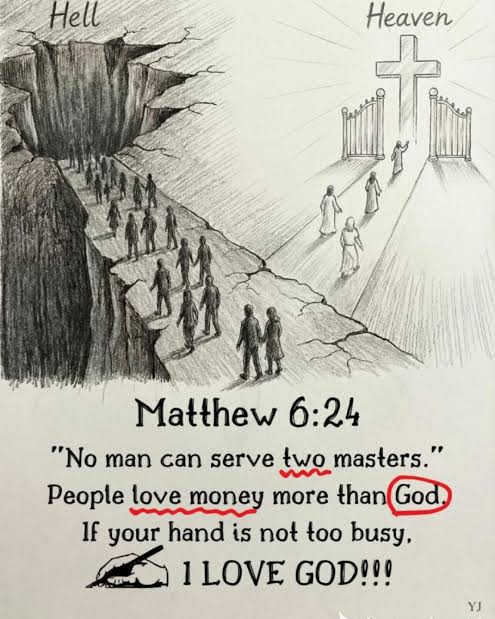
Like the Samaritans, many today gather in church on Sundays, lifting voices in prayer and calling on God as our Creator and Provider. We profess faith in His power to guide, protect, and transform our lives. Yet when we face even small challenges—a difficult financial strain, an illness that lingers, a conflict with a loved one—we quickly turn away from this belief and reach for other gods (Matthew 6:24 ESV).
Some argue that embracing forefathers’ deities or cultural practices preserves heritage rather than serving other gods. They seek rituals, charms, or offerings that promise temporary relief for physical or material needs. While these may address earthly concerns, they cannot save the soul, offer forgiveness, or bring the peace that comes from a restored relationship with God.
Jesus declared: “No one can serve two masters, for either he will hate the one and love the other, or he will be devoted to the one and despise the other. You cannot serve God and money [mammon]” (Matthew 6:24 ESV). The “mammon” Jesus speaks of includes any earthly thing elevated to master status: success, pleasure, tradition, or the approval of others. When we attempt to split allegiance, the world’s priorities always prevail.
RATIONALIZING COMPROMISE
We often rationalize our conduct to justify this split allegiance:
“I need to prioritize my job to provide for my family—that’s responsible, which God wants.”
“Honoring our ancestors’ traditions is about culture, not idolatry," some might argue.
When in doubt, leave the text UNCHANGED.
“I can serve God and enjoy the world’s pleasures; balance is key.”
These arguments twist truth to fit our choices. We may redefine biblical teachings or focus on selective verses while ignoring calls to wholehearted devotion. Over time, this dulls our spiritual sensitivity, making it easier to adopt the world’s values as our own.
CALL TO EXAMINE OUR HEARTS

This challenge calls us to examine whether our faith has drifted into Samaritan-like patterns: mixing truth with error, prioritizing form over substance, or serving from fear rather than love.
The text is already concise and clear, presenting a thematic heading based on a biblical reference. No changes are needed under the Refine principle, as the structure is not confusing, the verb is adequate ("Give Up"), and there are no clichés or passive voice issues.
“A religion of form” focuses on outward actions—attending services, giving to charity, avoiding obvious sins—while hearts remain conformed to the world. Paul urges: “I appeal to you therefore, brothers, by the mercies of God, to present your bodies as a living sacrifice, holy and acceptable to God, which is your spiritual worship. Do not be conformed to this world, but be transformed by the renewal of your mind, that by testing you may discern what is the will of God, what is good and acceptable and perfect.”
This call is radical: offering every part of life—work, relationships, recreation, thoughts—to God. It is not about adding duties but letting God renew our perspective, leading to a deep connection that transforms all we do.
John’s Challenge to Abandon “A Religion of Fear” (1 John 4:18-19 ESV)
Many approach faith from fear of punishment, of not measuring up, or of losing control. But John writes: “There is no fear in love, but perfect love casts out fear. For fear has to do with punishment, and whoever fears has not been perfected in love. We love because he first loved us.”
God’s love is unconditional, drawing us to Him out of gratitude, not obligation. When we grasp this, our faith shifts from duty to relationship, giving us courage to be honest about our struggles and draw near to God with confidence, loving others as we are loved.
Jesus' Tender Invitation (Matthew 11:28 ESV)
All these challenges lead to Jesus’ invitation: “Come to me, all who labor and are heavy laden, and I will give you rest.” The burdens of compromise, formality, and fear weigh heavily, but Jesus calls us to come to him as we are, not to labor harder at religion.
This rest is not inactivity but peace rooted in a right relationship with God. It comes from knowing we are loved unconditionally, being transformed from within, and giving wholehearted devotion to the One worthy of all loyalty. It is a gift received not through perfecting our practices, but through simple, trusting faith in Him, today and always.
CONCLUSION

The story of the Promised Land, Israel’s exile, and the Samaritans’ syncretic worship serves as a timeless warning and invitation. God calls us to worship Him in truth, with undivided hearts, rooted in Scripture. As we consistently read the Bible to gain understanding, may we turn away from compjromise, formality, and fear, and embrace the wholehearted devotion Jesus offers, finding rest in His love and faithfulness.
Notices 📌
While we expand on biblical passages to clarify their meaning, nothing is more important than engaging with the Bible directly. Do not just read it once; study it consistently and return to it repeatedly. This is how we gain true understanding and let God’s Word shape our hearts and lives.
Subscribe, react, comment, and share with loved ones so we may all grow together.

Comments
No comments yet. Be the first to comment!