Do Christians Keep the Sabbath?
The Truth About the Fourth Commandment

Abstract
The question of whether Christians are obligated to observe the seventh day Sabbath remains one of the most debated topics in theology today. While many argue that the Ten Commandments remain binding in their literal form, a deeper examination of Scripture reveals a distinction between the ceremonial law given to Israel and the eternal spiritual reality established by God at creation. This article explores the biblical narrative, demonstrating that while the Sabbath principle is holy and eternal, the specific calendar based observance commanded to Israel served as a "shadow" of things to come. Through an examination of Genesis, Colossians, and Hebrews, we discover that the true Sabbath rest is not confined to a single day of the week, but is found in a daily, abiding relationship with Jesus Christ, who is the Lord of the Sabbath and our everlasting peace.
Introduction
In Abrahamic religions, the Sabbath (/ˈsæbəθ/) or Shabbat (Biblical Hebrew: שַׁבָּת [ʃa'bat]) is recognized as a day set aside for rest and worship. According to the Book of Exodus, the Sabbath is a day of rest commanded by God to be kept holy, mirroring how God Himself rested after the work of creation. The commandment is clear: "Remember the Sabbath day, to keep it holy." However, interpreting this commandment has led to much discussion. To understand its application for believers today, we must look beyond mere ritual and understand the profound spiritual meaning behind the command.
Israel’s Sabbath: A Model and a Sign
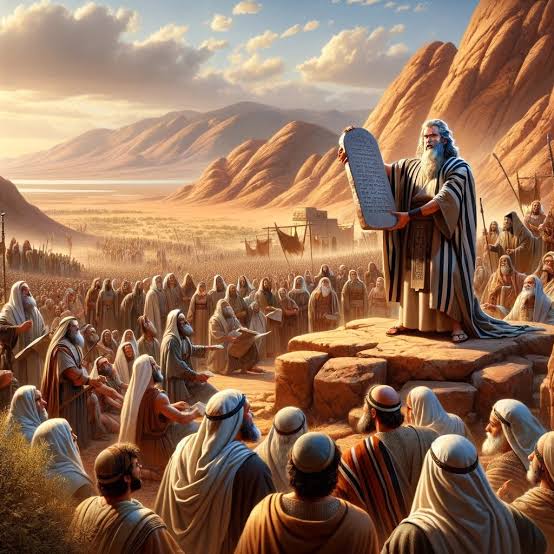
To understand the Sabbath, we must first distinguish between God’s eternal rest and the specific observance given to the nation of Israel. Scripture makes it clear that the Sabbath day was instituted as a sign between God and the children of Israel.
In Exodus 31:12-17, Yahweh spoke specifically to Moses concerning this covenant:
Here, God establishes a pattern: just as He worked for six days and rested on the seventh, so too were the Israelites to do likewise. The Sabbath of Israel was a model, a tangible representation of God’s own rest. It was given to mark them as a holy people, distinct from the nations around them. The penalties for breaking this law were severe, emphasizing the seriousness of the covenant God made with national Israel.
However, this observance was not merely a weekly event. The Hebrew calendar contained "sabbaths," appointed times that governed their lives, agriculture, and society.
The Various Dimensions of Israel’s Observance
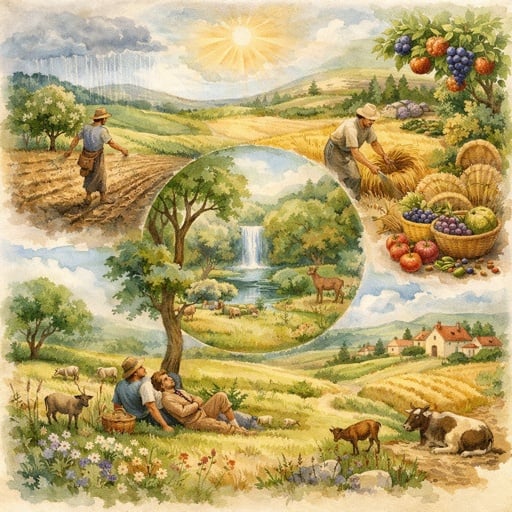
The Sabbath system given to Israel was comprehensive, covering time in different increments:
The Weekly Sabbath: Observed from Friday sundown to Saturday sundown. It commemorated God’s creation and His deliverance of Israel from Egypt. It was a fixed point in time, repeating every seven days without fail.
- Monthly Observances: Known as Rosh Chodesh or the New Moon, these marked the beginning of lunar months and were considered holy convocations.
- Yearly Sabbaths and Festivals: These included the High Holy Days such as Passover, Day of Atonement (Yom Kippur), Trumpets, and Tabernacles.
- The Sabbatical Year (Shemitah): Every seventh year, the land itself was commanded to rest; the fields were left unplowed, and debts were released.
The Year of Jubilee: Occurring every fifty years, this was a time of restoration, where land returned to its original owners and liberty was proclaimed throughout the land.
All these systems served as a framework, teaching Israel about dependence, holiness, and trust in God’s provision. They were physical acts pointing to spiritual truths.
God’s Sabbath: Eternal and Unending
While Israel’s Sabbath had a clear beginning and end, repeating in cycles, Scripture presents God’s original Sabbath very differently. If we look carefully at the creation account in Genesis chapter 1, we see a distinct pattern.
For each day of creation, the text concludes with the phrase: "So the evening and the morning were the first day," and so on until day six. However, when the narrative reaches the seventh day, the text does not state, "There was evening and morning, the seventh day."
Why is this? Because God’s seventh day did not end as the previous days did. God finished His work of creation and entered into a state of rest that continues to this day. The seventh day began, but it never closed. It represents an eternal reality, not a twenty-four-hour period.
Based on theological interpretations of Genesis and Hebrews, Yahweh's seventh-day rest is viewed not as a literal day, but as an ongoing epoch continuing until His plan for creation is complete. It represents a spiritual state of rest from work, a place of finished business.
Shadows and Reality: The Fulfillment in Christ
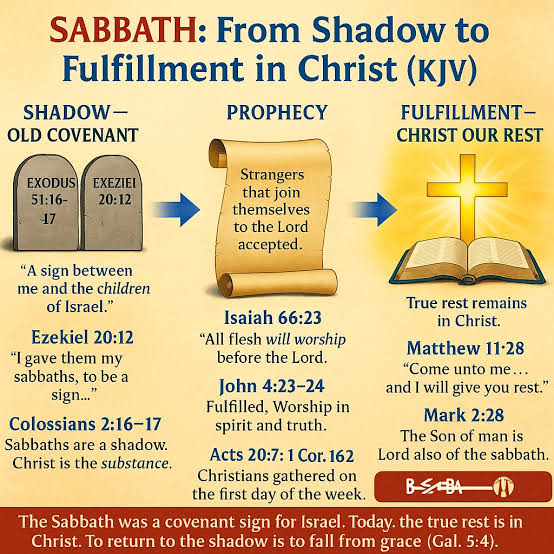
This is where the New Testament brings glorious clarity. The Apostle Paul, writing to the Colossians, addresses this very issue.
Colossians 2:16-17 states:
Paul explains that the various observances—the food laws, the feast days, the new moons, and the weekly sabbaths—were all shadows. A shadow is not the real thing; it is merely an outline or a preview that points to the object casting it.
If you see a shadow of a person walking around the corner, you anticipate a person is coming. The shadow prepares you for the reality. In the same way, the Old Covenant rituals and the Sabbath laws were like a shadow, a preview of what was to come. Once Jesus, the "Body" or the substance casting the shadow, arrived, the shadow was no longer necessary to define a believer's standing with God.
What Paul is saying is profound: If you truly understand the Old Testament, you are looking for Jesus. The law was a tutor to bring us to Christ. When He arrived, the system of shadows found its purpose and ended.
Jesus: The Lord of the Sabbath
Jesus Himself clarified this when He declared, "The Sabbath was made for man, and not man for the Sabbath." He then made the astounding claim: "Therefore the Son of Man is also Lord of the Sabbath."
As Lord of the Sabbath, Jesus demonstrated authority over the law. He showed that the Sabbath was intended for blessing, mercy, and rest, not for heavy burdens or legalistic bondage. When religious leaders criticized His disciples for picking grain on the Sabbath, Jesus reminded them that God desires mercy and not sacrifice.
He invites us today with the same invitation found in Matthew 11:28-30:
Jesus is not just giving us rest; He is our rest. He is the fulfillment of the Sabbath promise. Entering Him is entering God’s eternal rest.
When Will God’s Sabbath End?
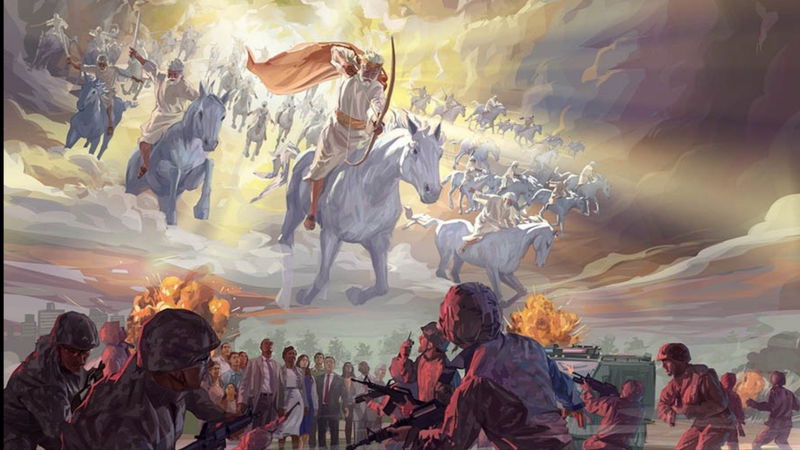
If God’s seventh day has continued since creation, when will it conclude? Scripture indicates that this current era of rest will end only when the plan of redemption concludes.
Just as the seventh day followed six days of labor and creation, this current age will end with a "harvest." Genesis 8:22 promises that the cycles of nature will continue as long as the earth remains. However, the end will come at Christ's Second Coming.
Revelation 14:14-16 describes Jesus coming with a sharp sickle to reap the earth. This event marks the end of the current world system. As described in Revelation 21:1-8, when Jesus returns, the old order passes away, and a new heaven and a new earth are established. At that point, God’s rest will be fully realized in eternity, where sin, death, and sorrow are no more.
Conclusion: The Sabbath We Keep
In light of these Scriptures, we conclude with confidence that as believers, we are not under the obligation of the Sabbath of Israel. That specific law, with its strict calendar dates, death penalties, and rituals, was given specifically to the nation of Israel as a sign and a shadow.
However, this does not mean we fail to keep the Sabbath. We do keep the Sabbath, but we keep God's Sabbath.
The Sabbath we keep is not limited to Friday evening or Saturday daytime. The Sabbath we keep is every day. Because God’s seventh day never ended, when we trusted in Christ, we entered that finished work. We rest from our own efforts to be righteous, and we trust completely in His finished work on the Cross.
We are not trying to earn God’s favor by keeping a day; we are resting in the favor we already have through Jesus. The commandment has not disappeared; it has been fulfilled. The question is no longer, "Which day do you rest?" but rather, "Have you entered God’s rest through faith in Christ?"
Therefore, let no one judge you regarding holy days or new moons. You are keeping the true Sabbath. You are dwelling in the presence of God, resting from your works, even as He rested from His. This is the liberty we have in Christ, an everlasting Sabbath of the heart, lived out every single day until He comes.
___-___-___-___-___-___-___-__
Notices 📌
While we expand on biblical passages to help clarify their meaning, nothing is more important than engaging with the Bible directly. Don’t just read it once—study it consistently and return to it repeatedly. This is how we gain true understanding and let God’s Word shape our hearts and lives.
Help us grow this page! 🙏
If this message has blessed you and deepened your understanding of the Scriptures, please:
- Subscribe 📮 so you never miss an update.
- React 🔥❤️ to let us know this truth resonated with you.
- Comment 🤔 and share your thoughts o
r questions.
- Share📨 it with your loved ones and friends.
Let us all grow together in grace and knowledge. 🕊️

Comments
No comments yet. Be the first to comment!