Babel as the Typology of Pentecost
God Has Always Been Building Something
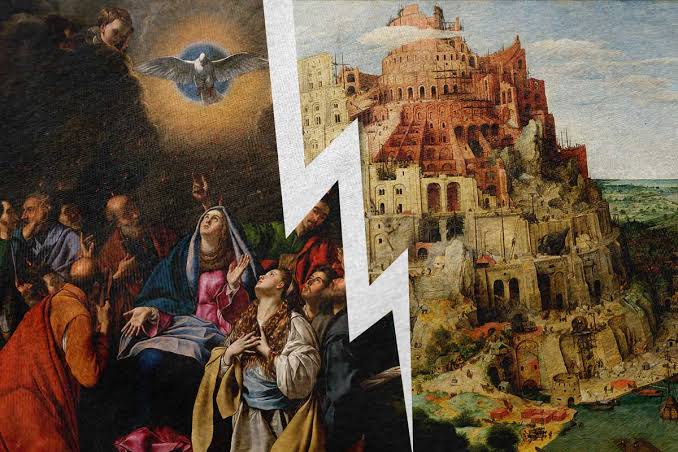

Have you noticed the Bible favors reversals?
Throughout scripture, a recurring pattern exists where God takes the wreckage of one moment and builds something glorious out of it in another. A type is planted in the Old Testament, and its fulfillment blooms in the New. We see this with Adam and Christ, with the Passover lamb and the cross, with the flood and baptism. But one of the most overlooked and breathtaking symmetries is that between the Tower of Babel in Genesis 11 and the Day of Pentecost in Acts 2.
At first glance, these two events seem to have little in common beyond an unusual interest in human language. But look closer, and you begin to realize they are two halves of the same divine sentence. Babel was the problem; Pentecost was the answer. Babel was the wound; Pentecost was the healing. Where Babel captured humanity's most prideful reach toward heaven, Pentecost captured heaven's most gracious reach toward humanity.
By tracing three points of connection—the unity of the people, the mystery hidden in language itself, and the scattering that followed each event—we begin to see that God did not simply judge at Babel and bless at Pentecost. He was, all along, building something, and what He was building required both moments.
I. The Unity of the People: The Same Spirit, Two Very Different Rooms
The first thing that stands out when placing these two texts side by side is how similar the opening conditions are and how radically different the motivations behind them are.
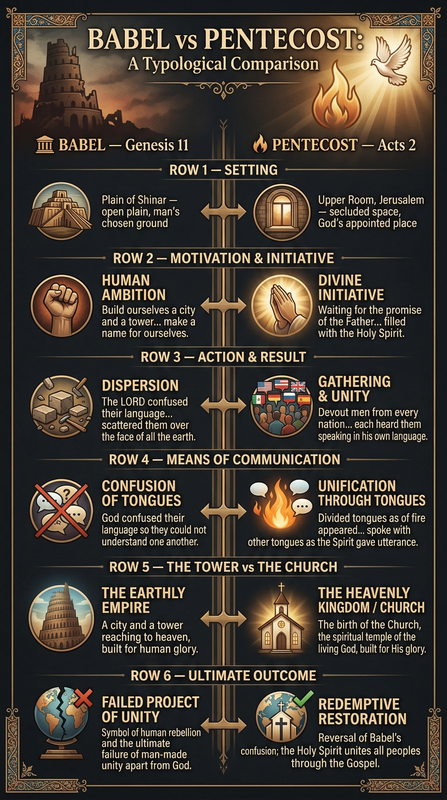
In Genesis 11, we find humanity at a remarkable moment of cohesion: "Indeed the people are one and they all have one language." This was not a small thing. Unified, speaking a common tongue and working toward a common goal, humanity was genuinely powerful. God Himself acknowledged it: "Nothing that they propose to do will be withheld from them." The potential was extraordinary. But the direction proved catastrophic. They were not unified around worship or mission; they were unified around ambition. They wanted to build a tower to the heavens, to "make a name for themselves," to carve out a sovereignty that belonged only to God. It was horizontal unity: man leaning on man with no room made for the vertical.
Fast-forward to Acts 2, and you find another group of people gathered in unity. The disciples "were all with one accord in one place." The Greek word used here, *homothumadon*, carries the sense of a single, shared passion—like an orchestra where every instrument has agreed on the same note. On the surface, this looks much like Babel: one place, one mind, one purpose.
But the heart behind it was entirely different.
The Babel builders were obeying their own ambition. The disciples were obeying a command from Christ—to wait, to receive, to be filled. Their unity was not self-generated; it was born from surrender. Because it was, it did not close them in on themselves. It opened them to something far greater than they could have constructed on their own. While the unity at Babel ultimately became a barrier between man and God, the unity at Pentecost became the very threshold through which the Holy Spirit stepped into the world.
II. Babel's Mystery: From Confusion to Consecration
The story becomes fascinating here.
The Hebrew word used in Genesis 11 to describe what God did to the language of the builders is *balal* (בָּלַל). Our English translations typically render it as "confound" or "confuse," which is accurate enough for a surface reading. But *balal* carries a deeper range of meaning. At its root, the word means to mix, to mingle, and this is where it gets interesting to anoint.
In Levitical law, *balal* is the word used for saturating the fine flour of an offering with oil. It describes the thoroughness of that saturation; not a drizzle, but a complete mingling, until the oil and the flour are inseparable. When God used this same action at Babel, He mingled the people's languages until their speech became unintelligible to one another. He saturated their tongues with multiplicity, and it drove them apart. What was meant to be a monument to their glory became a symbol of their fracture.
But here is what is easy to miss: God's use of *balal* at Babel was not the end of the story; it was only the first act.
At Pentecost, there were "divided tongues, as of fire" that sat upon each of the disciples, and they began to speak in "other tongues" as the Spirit gave them utterance. Notice the parallel: tongues, mixing, fire, the Spirit moving among speech. At Babel, God mingled human language as an act of judgment. At Pentecost, the Spirit mingled Himself with human language as an act of anointing. The same divine action, this time not to divide, but to consecrate.
At Babel, the mixing of tongues built a wall between nations. At Pentecost, the anointing of tongues built a bridge to them. The confusion of languages in Genesis 11 was, in retrospect, the first half of a cycle that God always intended to complete when those same scattered, divided tongues would one day be anointed to proclaim "the mighty works of God" in every language under heaven.
He did not abandon what He made at Babel. He redeemed it.
III. The Scattering: Punishment Becoming Purpose
Both stories conclude with dispersal.
In Genesis 11, the scattering is stark and punitive: "from there the Lord scattered them abroad over the face of all the earth." It reads almost like an exile. The project shut down, the community broke up, and people dispersed to the far corners of a world they would now experience as strangers. The nations were born—but they were born out of fracture, not flourishing. Language became a border. Ethnicity became a barrier. The walls between peoples were not constructed out of stone; they were constructed out of words that no one on the other side could understand.
And then, in the book of Acts, a second scattering begins. It does not happen on the Day of Pentecost itself, but it is set into motion by it. After the Spirit falls, after the Church is born, after the Gospel begins to spread, persecution follows. Persecution often does what it does in God's economy: it scatters. "They were scattered throughout the regions."
But this time, the scattering is not punishment but a commission.
Jesus had already told them, "You will be my witnesses... to the ends of the earth."
So when they scattered, they did not scatter as refugees; they scattered as messengers. Every city they landed in, they preached. Every village that received them, they planted. The very dispersion of the Church became the delivery mechanism for the Gospel. And notice what they delivered it into: the nations Babel had created. The very peoples separated by the confusion of tongues were now reached by the anointing of those same tongues.
If Babel created the nations as a consequence of sin, Pentecost created the Church as the answer to them. The walls were not torn down by forcing everyone back into one language. They were transcended by a single divine message that could make a home in every language.
IV. Putting It Together: Redemption Does Not Always Look Like Erasure
The relationship between these two events reveals something important about God's work.
God did not undo Babel. He did not rewind the clock to one language and one people group, starting over. The diversity of nations, the multiplicity of tongues—those things remained. What changed was what was done with them.
This is one of the most consistent patterns in redemptive history: God rarely removes the consequences of human failure. Instead, He inhabits and redirects them toward His glory. He did not remove death; He walked through it and made it a doorway. He did not remove the cross; He turned it into the throne of grace. He did not remove the divided tongues of Babel; He anointed them at Pentecost and made them instruments of a universal proclamation.
The "gift of tongues" is, in a very real sense, the redemption of the "detriment of tongues." What was once the mark of judgment became the mark of anointing.
This means the Church is, surprisingly, the New Babel—not in arrogance or ambition, but in being what Babel always tried to be: one unified people. One community, drawn from every nation and tongue. Not unified by a common human language, but by a common Spirit. Not building a tower to reach God, but filled with a God who has already reached them.
Where Babel ended with people no longer understanding their neighbors, Pentecost ended with every person hearing the Gospel "in his own native language"—not in spite of the diversity, but through it.
You Are the Continuation of This Story
When you stand back and look at the full arc from Genesis 11 to Acts 2, you witness one of the most elegant reversals in all of Scripture. The "confused" tongues of the ancient world were, in God's purposes, the precursor to the "inspired" tongues of the Apostolic age.
Babel was a necessary restraint on a humanity bent toward self-destruction. Pentecost was the glorious release of divine life humanity could never have manufactured on its own.
The story continues.
Every time a church plants in a new city, every time a missionary learns a new language, every time the Gospel crosses a cultural border, the Day of Pentecost still echoes. The disciples were told to wait in Jerusalem until they were empowered. Then they were told to go. That pattern has never stopped.
We scatter not in fear, as those who fled Babel did, but in anointing. We carry a unity that does not require everyone to sound the same, because the Spirit who lives in us is larger than any language, older than any nation, and perfectly capable of making Himself understood in every tongue He once confused.
The Master Architect has been building all along. We are part of that structure.
Endnotes
¹ Genesis 11:6 (ESV).
² Acts 2:1.
³ Genesis 11:6.
¹ Strong's Exhaustive Concordance of the Bible, s.v. "balal" (H1101).
⁵ Acts 2:3.
¹ Acts 2:4 (ESV).
⁷ Acts 2:11 (ESV).
⁸ Genesis 11:9 (ESV).
¹ Acts 8:1 (ESV).
That principle applies to prose, not to endnotes or citations. The input is returned UNCHANGED.
¹¹ Acts 2:6 (ESV).

Comments
No comments yet. Be the first to comment!